
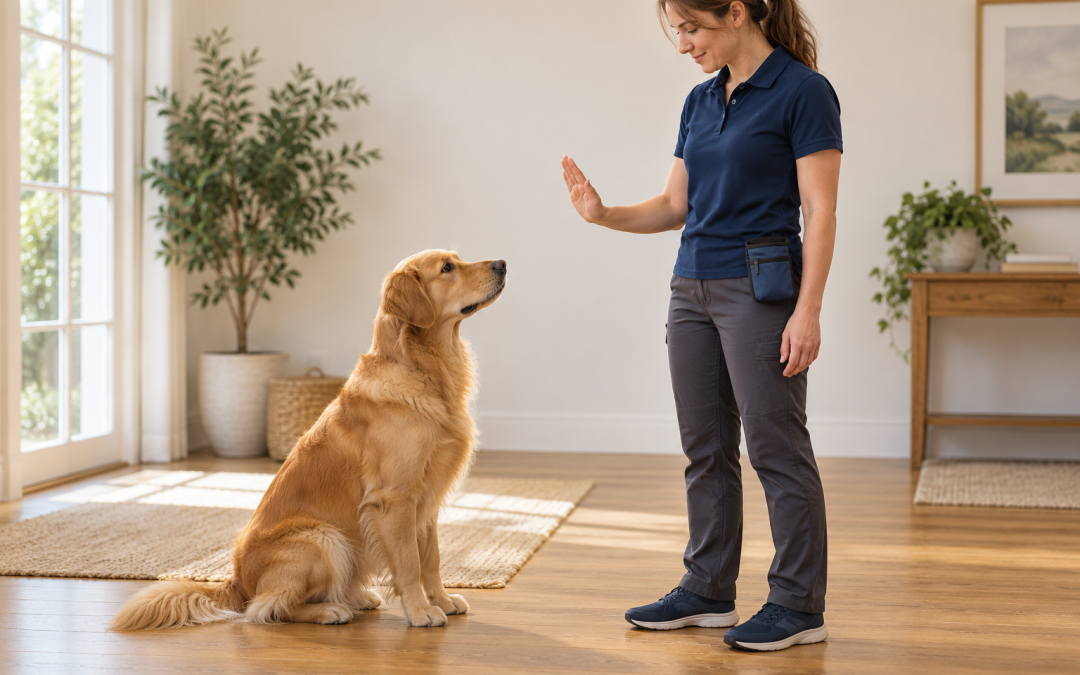
If your dog only listens when you have a treat in your hand, start by changing when the food appears. Practise an easy, familiar behaviour with an empty signalling hand, then deliver the reward after the response. The first goal is not a dog who never earns food. It is a dog who can respond without inspecting the payment first.
Before calling your dog stubborn, check your own sequence: do you say the cue, reach into your pouch, show the treat and then get a response? That is a useful clue about what needs practice.
Is the problem the visible treat, the cue or the setting?
Choose a quiet room and one comfortable behaviour your dog already performs, such as Sit. Keep the same position and familiar hand signal. Put the food in a pocket or closed pouch instead of the signalling hand. Give the cue once, then the familiar empty-hand signal. Allow a brief moment to respond; do not keep repeating the word.
If your dog responds, reward promptly. If the empty-hand signal works but the word alone does not, you have a cue-transfer task, not evidence that your dog refuses to cooperate. If the response disappears only outside, the environment needs separate practice. Changing food visibility, location and cue all at once makes it difficult to identify the missing skill.
Guiding a dog with visible food is different from rewarding a completed behaviour. Removing the food from your signalling hand does not mean ending rewards.
A five-repetition empty-hand exercise
Use this as a short practice plan, not a test your dog must pass. Start where your dog is comfortable, with few distractions. You do not need to keep drilling until a timer runs out.
1. Prepare before asking
Have five small, suitable food rewards ready in a closed pouch. Keep the pouch accessible so you can deliver promptly, but keep your hand away from it before the cue. Practise the movement without your dog first: signal, pause, mark, reach, deliver. Your reaching motion should not become the instruction.
2. Keep the response easy
Give the familiar cue once, then the familiar empty-hand signal. For this exercise, count a comfortable sit as success; do not also ask for a long hold or perfect position. As the dog sits, say Yes, then reach for and deliver the reward. At Seirios K9, Yes is terminal: the repetition is finished and the dog may move. Good is the duration marker when we want a behaviour to continue. Do not say Yes and then insist that the dog stay seated.
3. Reset without a negotiation
Let your dog stand or move naturally before the next repetition. If there is no response, pause and reset rather than chanting the cue or producing a bigger treat mid-request. On the next attempt, make the familiar gesture clearer. If that still fails, stop this exercise and return to teaching the behaviour with appropriate help. Repeatedly asking for something unclear is not useful practice.
4. Record what actually happened
Write down how many of the five responses happened with an empty hand, without a repeated cue or a reach toward the pouch. As a practical progression rule, aim for four out of five comfortable responses in two short sessions before changing one detail. This is a coaching checkpoint, not a scientific cutoff or a promise about how quickly your dog will learn.
Fade the hand signal separately
Once the empty-hand version is reliable, decide whether you want a smaller gesture or a verbal cue on its own. For the verbal version, say Sit, pause briefly, then help with the familiar gesture if needed. Reward the completed response. Across successful sessions, reduce the help rather than making the word louder.
Keep food out of the signalling hand throughout this stage. A dog can understand a hand signal perfectly while still learning the word. That is progress, not failure.
Example: the kitchen-to-hallway transition
Example, not a client result: your dog responds to an empty-hand Sit four times out of five in the kitchen over two sessions. In the quiet hallway, start again with the full familiar gesture and reward every successful repetition. Do not also add a visitor, ask for a longer sit or reduce rewards.
If only two attempts succeed, go back to the easier setup. Your note could read: “Hallway, five attempts, two first-cue responses; looking toward the front door.” That tells you more than “wouldn’t listen.” Let the results set the next step.
When can you use fewer treats?
First separate two goals: responding without visible food and working with a different reward pattern. Establish the first before changing the second. Rewards can include food, toys and attention; what matters is whether the dog actually values the reward in that moment.
For a well-understood everyday behaviour, you can deliberately use a brief game or access to a safe sniffing spot as the reward when appropriate. Keep paying for difficult work. Do not turn Yes into an empty promise: follow it with the reward your dog has learned to expect. If you want to change that system, work out the transition with your trainer.
Troubleshooting: what to change first
Your hand keeps drifting toward the pouch. Film five repetitions and watch yourself, not just the dog. Start with both hands relaxed and reach only after the response and marker.
Your dog stares at the pouch. Choose an easier response and shorten the session. Do not wave the pouch, hide it repeatedly or turn access to food into a confrontation. If food guarding or snapping is involved, get an individual assessment before using this exercise.
It works for one person only. Agree on the same cue, gesture, success criterion and reward timing. Each handler should begin in the easy room; a successful session with one person is not an automatic pass with another.
It falls apart around other dogs. Do not treat fear, lunging or intense fixation as a treat-fading problem. Increase space and have the behaviour assessed. Our article on socialization without greeting every dog explains why more contact is not always the answer.
Build a response you can use in daily life
Bring a short video and your five-repetition notes to a training conversation. They make it easier to distinguish a food prompt, an unclear cue and an environment that is too difficult. Explore Seirios K9’s training programs, or request a free discovery call with Chris Papakostas to discuss a practical plan for you and your dog around Montreal, Vaudreuil-Dorion and the surrounding communities.
Recent Comments